THE ROMANTIC POETS IN ITALY
ROUTE: Pontremoli (Tuscany) via Sarzana to Lucca (Tuscany)
DURATION: 7 days (128 km)
DATES: 22nd April – 28th April
A poem needs understanding through the senses. The point of diving into a lake is not immediately to swim to the shore but to be in the lake, to luxuriate in the sensation of water. You do not work the lake out, it is a experience beyond thought. Poetry soothes and emboldens the soul to accept the mystery.
John Keats
The Romantics might be described as the original ‘snowflake generation’. They expressed deep sensitivity and often sentimentality in their poetry as well as championing causes and being ‘woke’ to the issues that faced Georgian society. When we talk about Romantic verse, the poets we generally consider are John Clare (1793-1864) William Blake (1757-1827), William Wordsworth (1770-1850), Samuel Taylor Coleridge (1772-1834), George Gordon, 6th Lord Byron (1788-1824), Percy Bysshe Shelley (1792-1822) and John Keats (1795-1821). Our journey will focus on the last three: Byron, Shelley and Keats who had a particular connection to the landscape we’ll be walking through. I hope to cover a lot of ground (!) and take a look at some of their contemporaries as well as exploring the reasons they sought refuge in Italy.
Today the word ‘romantic’ evokes images of love and sentimentality, but the term ‘Romanticism’ has a much wider meaning. It covers a range of developments in art, literature, music and philosophy, spanning the late 18th and early 19th centuries. The ‘Romantics’ would not have used the term themselves: the label was applied retrospectively, from around the middle of the 19th century.
Dr Stephanie Forward
Although we may associate Byron more with Venice and Ravenna (he had arrived in Italy in the winter of 1816) he relocated to Pisa in 1821. It was perhaps his most intensely productive period, finishing Cantos 6–12 of Don Juan there by 1822. In the spring of 1818 the Shelleys (Percy and Mary) left England for a final time. They had met up with Byron two years previously in Geneva but from 1819 were based in Tuscany, moving from Livorno, to Florence then Pisa and finally Lerici, in Liguria.
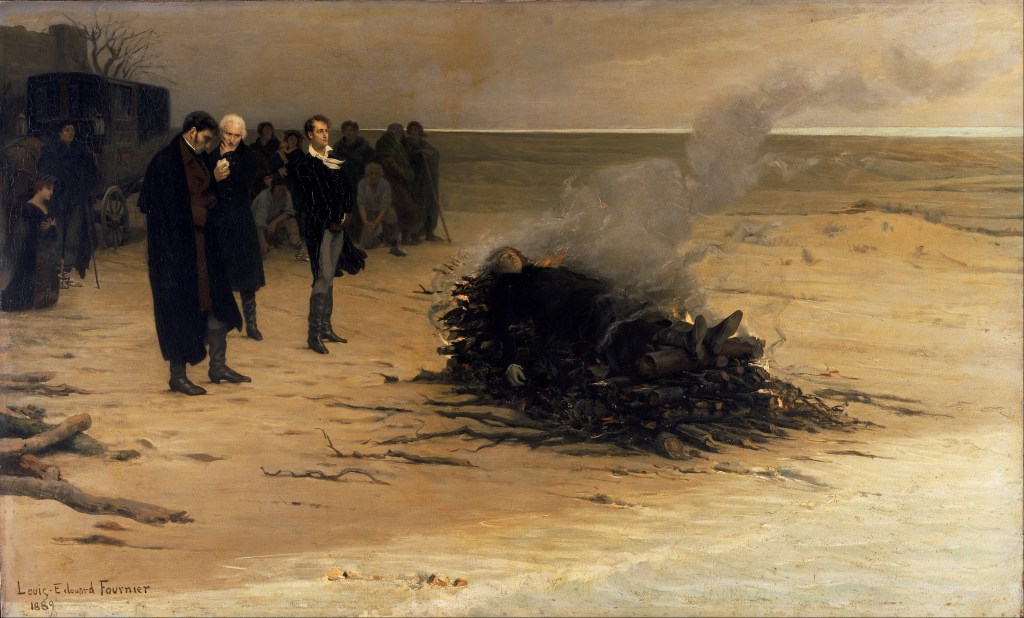
Keats had landed in Naples in poor health in October of 1820 and tragically never received a letter Shelley had sent inviting him to take the healthier air on the coast near Pisa. He died of tuberculosis in Rome in February 1821. Percy Bysshe Shelley drowned in 1822, his yacht wrecked in a storm in the Gulf of La Spezia. His body, washed ashore at Viareggio ten days later, only identified as that of the missing English poet from his personal copy of Keats’s Lamia found in his jacket pocket. He was cremated on the beach, his remains later buried, along with Keats, at the Protestant cemetery in Rome.
My heart aches, and a drowsy numbness pains
My sense, as though of hemlock I had drunk…
from “Ode to a Nightingale” by John Keats (1819)
Fournier’s painting shows the funeral pyre on the Tuscan coast and, from left to right, the author and adventurer Trelawny and fellow-poets Leigh Hunt and Lord Byron. Byron moved from Pisa to Genoa and then left Italy in the summer of 1823 for Greece where he died in 1824. This painting, made in 1869, is significant in that it did much to not only preserve the legacy of the romantic poets in Italy but also helped add an element of myth to it too. As well as looking at their poetry we’ll be investigating stories about them, both true and disputed, and why the age in which they lived very much mirrors our own.
 JAN NOBLE